LaboratoriesLaboratory for Biocenology and Historical Ecology \  Goals and Tasks

Laboratory for Biocenology and Historical Ecology

Headed by A. B. Savinetsky, Dr. Sc.(biol.)


tel. (495)-633-14-17


Main Goals and Tasks


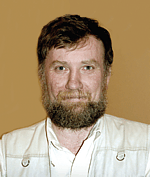
The head of the group A.B. Savinetskiy


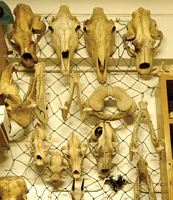
The sculls of mammals out of comparative osteological collection
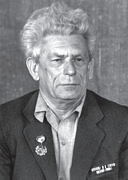

Doctor of Biological Sciences
L.G. Dinesman


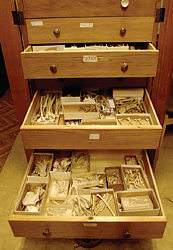
Comparative collection of the bones of modern birds

The main directions of basic research of the Department of Biological Sciences of the RAS (being developed in the Lab):

  • Developmental biology and evolution of living systems.
  • Ecology of organisms and communities.
  • Biological diversity.

The research activity of the V.N. Sukachev’ Laboratory for Biogeocenology and Historical Ecology can be divided into two main areas: the studies in the field of general biogeocenology and in the field of historical ecology.

In the field of biogeocenology the main attention was paid to the study of the spatial structure of forest biogeocenoses, spatial and temporal variability of the energy, water and carbon dioxide fluxes in different types of ecosystems of the boreal forest zone, stability of forest ecosystems and prediction of their possible future changes. These studies were carried out using field measurements, remote sensing data, aircraft measurements, and the process-based mathematical models of different scales and levels of complexity.

The different methods allow to describe the response of the forest ecosystems to changes of environmental conditions in different temporal scales from high (with a time step from one minute to 24 hours), and middle frequencies (month, season, year) to low (from one year to 100 years) and ultra-low frequencies (from 500 years to 15000 years). Depending on temporal scale, the following methods were applied: ecophysiological methods (solar radiation absorption by leaves, trees and canopy, stomatal regulation of water and ÑÎ2 exchange between leaves and ambient air, tree water uptake and transpiration, daily and seasonal dynamics of net photosynthesis of leaves and trees, CO2 and H2O exchange at the levels of the tree crown, forest stand and entire ecosystem), forest taxation methods allowing the estimation of the dynamics of forest growth during 100-year period, and also paleoreconstructions of land-use and vegetation changes during the last 15000 years using pollen analysis.

The results of long-term continuous field measurements of ÑÎ2 and water vapor fluxes using the eddy covariance method in spruce forest ecosystems of the Central Forest State Biosphere Reserve (zone of Southern European taiga) during the period from 1998 to 2008 allowed to confirm the hypothesis that the boreal spruce forests of the Southern European taiga are the sources of ÑÎ2 into the atmosphere. It was shown that the carbon balance of spruce forests during summer periods in the area is very stable and doesn’t significantly change in long-term perspectives. For the estimation of the possible influence of future climatic changes on carbonic and water balance of boreal forests, mathematical models for energy, water and CO2 exchange between non-uniform forest landscapes and the atmosphere on regional and local scales were also developed and applied.

Using results of multiple field studies, databases of the FAO and the Institute for System Research (Vienna, Austria), literature data (about 5750 descriptions) as well as mean monthly climatic data, the world map of carbon pools in the soils with grid cell resolution about 1´1° was created. Carbon storage was estimated by the step by step discriminant analysis in which the carbon storages measured in the field were used as a dependent variable, and climatic variables were used as independent ones. The total amount of carbon stored in the Earth soils was estimated as about 1.35x10¹² C tons. The aggregated ecological and climatological analysis of the data allows the finding of the areas with maximal instability of vegetation cover and high sensitivity to the present climatic conditions. A working hypothesis assuming that the regions of maximal instability are characterized by high risk of the rapid (sometimes catastrophic) structural readjustments in biogeocenoses themselves and in their components (first of all in vegetation and animal populations) has been suggested as well.

On the basis of collected and processed palynological data for test regions on the territory of Eastern Europe, several map sets for taxons of Pinus, Betula, Alnus, Picea, Quercus, Ulmus, Tilia, Carpinis, Acer, Fraxinus, Fagus, Corylus for the last 15000 years with 500-years time step were created. On the taxon maps the stady-state ranges as well as ranges with a high probability of regressive and progressive changes were shown.

In the field of historical ecology the main attention was paid to description of dynamics of ecosystems of the North hemisphere in Holocene. For this purpose during the last years the paleo-dynamics of littoral recent ecosystems of the Bering Sea, including the coast of Chukotka, Kamchatka, the Commander and Aleutian islands, the forest ecosystems of non-chernozem zone of European part of Russia (Moscow, Tver and Vologda regions) and also of the Northern Caucasus, arid ecosystems of Mongolia, the south of European part of Russia and the desert Negev was intensively investigated. It was shown that the dynamics of the various ecosystems differed significantly and was strongly dependent on regional features. For example, in the littoral zone of the Bering Sea the dynamics of ecosystems was determined by the changing of abiotic factors - summer temperatures, precipitation amounts in warm and cold seasons, sea temperature, prevailing winds, sea water level, relief of the sea floor, dynamics of coastal zone etc. In the arid regions of Mongolia the determining factors in ecosystem dynamics were the permafrost degradation, dealluvial and aeolian processes, climatic factors (temperature and precipitation amount) and during the last thousand years the grazing pressure. In the Negev desert the determining factors were the amount and type of atmospheric precipitation, as well as the grazing pressure. In case of weakening of anthropogenic pressure, restoration of vegetation cover is possible even under increased aridity of the area. In the forest zone of the Northern Caucasus and European part of Russia a slightly different pattern was observed. The endogenous processes were prevailed in the areas. The impact of climate factors on these processes was very small. The steppe ecosystems are mainly influenced also by endogenous processes. However, the anthropogenic factors and, first of all, cattle breeding and agriculture played in the area a very important role also. At present their influence is significantly overlapped by also the climatic factors. Singularity of the data obtained is provided mainly by applied method, which includes the complex studies of sediments of different genesis, such as turfs, long-term shelters of mammals and birds, zoogenic sediments in the caverns and niches, alluviual, marine and lacustrine bottom sediments, archeological memorials, buried soils and many other objects. These objects were investigated by different methods: radiocarbon, paleozoological (including determination of the fossils of vertebrate and invertebrate animals), zoological, dendroclimatochronological, botanical (implying usually the determination of macroremains of the plants), phytolitic, diatomic, palynological, helminthological, stable isotopes and etc. The studies were provided by improved classical methods and the developed new approaches. For example, it was developed a method for estimation of the dynamics of the number of animal paleopopulations according to archeozoological data, method for determination of the dynamics of climatic parameters from the analysis of stable isotopes of oxygen in phytolites of cereals, method for measurements of radiocarbon activity of very small samples (about 0.2 g, that was 5-10 times smaller than the standard one) in dynamic conditions. These studies were provided using unique radiocarbon measuring equipment (available in our Laboratory), allowing the dating of the different materials.